


Hybrid Retrieval
Dual-path BM25 + vector ranking with late fusion
Combines sparse keyword matching with dense vector similarity for robust recall.
Read the full card →The engine
The reasoning runtime at the heart of the platform. It turns a question into a fully receipted, evidence-backed answer (retrieve, rank, synthesize) and signs a CROWN receipt proving exactly how that answer was built.
Retrieval economics
Each lane is a different way of remembering: exact words, meaning, relationships, people, time, structure. The engine runs them in parallel, and Adaptive Manifest Routing decides per query which lanes earn their tokens, learning from outcomes rather than knobs. The exit is a hard token_budget enforced server-side; metadata travels first, and content is admitted only when it pays for itself.
This is a measurable claim, not a philosophy: budgets return substantially fewer tokens than naive top-K stuffing on the same corpus at equivalent answer quality, the exact margin depends on corpus and query mix, so we point you at the methodology rather than a headline percentage, and the daemon's numbers are regression-gated in CI against pinned baselines.
query
"what did we decide about invoice rounding?"
token_budget=2000
AMR fusion
routes per query, learns from outcomes, no knobs
budget gate
1,940 / 2,000 tokens · server-enforced
Lanes that do not earn their tokens are skipped for that query, not merely down-ranked: the budget is a hard ceiling, and metadata rides ahead of content. Skipped lanes stay warm; the next query may need exactly them.
Every query runs a multi-stage pipeline: understand the question, retrieve candidate evidence, re-rank it into a balanced set, synthesize an answer with explicit links back to each supporting chunk, and emit a receipt. The same real path the benchmark and IQ suites run: no shortcuts, no mock corpus.
Two lanes run in parallel: sparse keyword matching (BM25) and dense vector similarity. Recall holds up whether the user's words match the source or express the same idea in entirely different vocabulary. The ranked lists are merged with reciprocal-rank fusion, and the fusion weights are tunable per corpus class and query intent.
The goal is not the single best passage but a representative set. Candidates are re-ranked on relevance, recency, source authority, and coverage diversity, so the answer reflects the breadth of what's known, not just the loudest match.
The receipt captures the original query, the retrieved chunks with their ranking scores, the synthesis rationale, and a BLAKE3 content-hash chain, so anyone can verify the answer was produced from the claimed evidence, without access to your data.
Verify a live receipt →Different parts of the corpus flow through different embedding tiers by importance and domain: a premium lane for a medical research corpus, a faster lane for general content. The lane metadata is written into every receipt, so retrieval conditions stay fully reproducible.
Because every retrieval decision is logged, an auditor can replay any past query against the historical corpus state and confirm the same inputs produce the same outputs, essential where answer provenance must withstand scrutiny.
Dual-path BM25 + vector ranking with late fusion
Combines sparse keyword matching with dense vector similarity for robust recall.
Read the full card →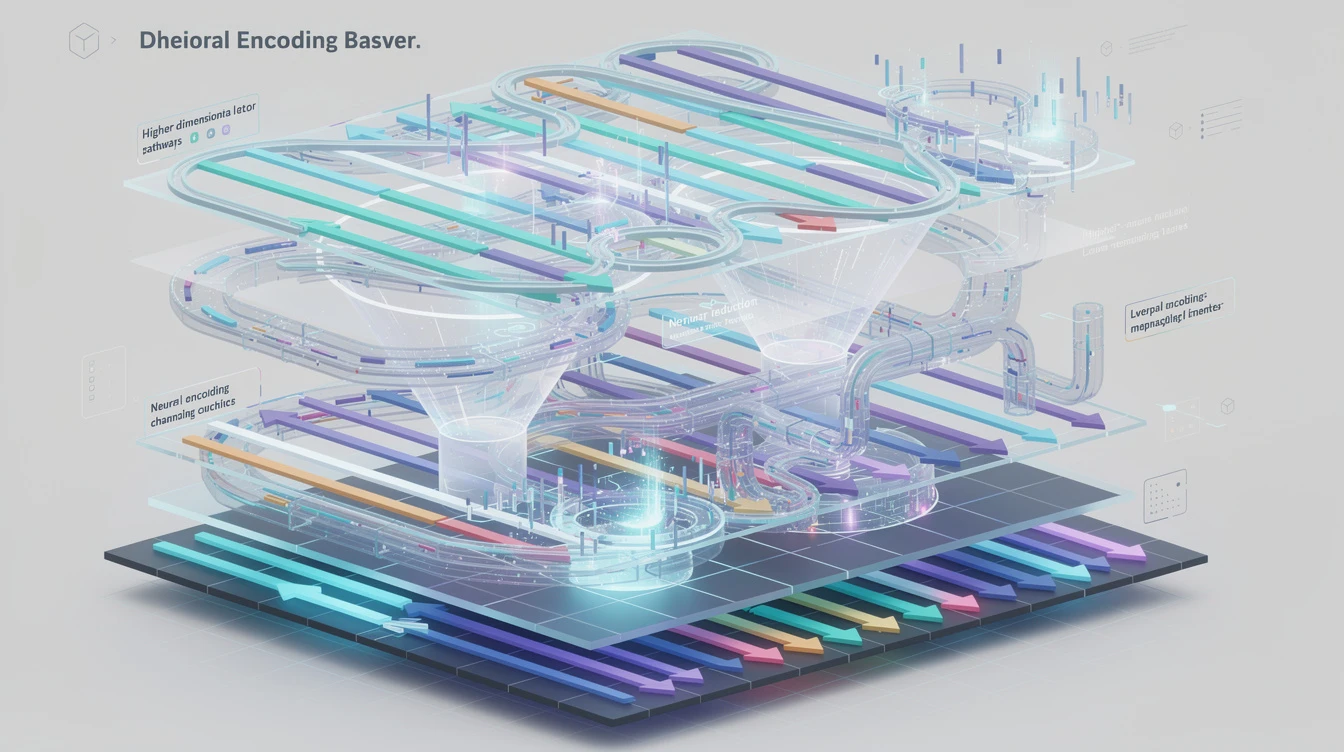
Four-tier embedding strategy with selective upgrades
Tiered embedding architecture balancing cost and recall across corpus classes.
Read the full card →
Query expansion via LLM-generated hypothetical answers
Generates hypothetical answer documents to improve retrieval of relevant evidence.
Read the full card →
Full-document embedding with token-level pooling
Embeds full documents first, then pools token embeddings into chunk vectors.
Read the full card →
Sentence-level breakpoints using embedding similarity
Splits documents at semantic boundaries rather than fixed token counts.
Read the full card →
LLM-driven factual claim identification
Extracts discrete factual propositions from source documents using LLMs.
Read the full card →
Multi-level RAPTOR summaries for broad recall
Builds tree-structured summaries at multiple granularity levels for broad queries.
Read the full card →
Three cost/rigor envelopes: light, verified, audit
Three processing tiers trading off speed and cost against evidence rigour.
Read the full card →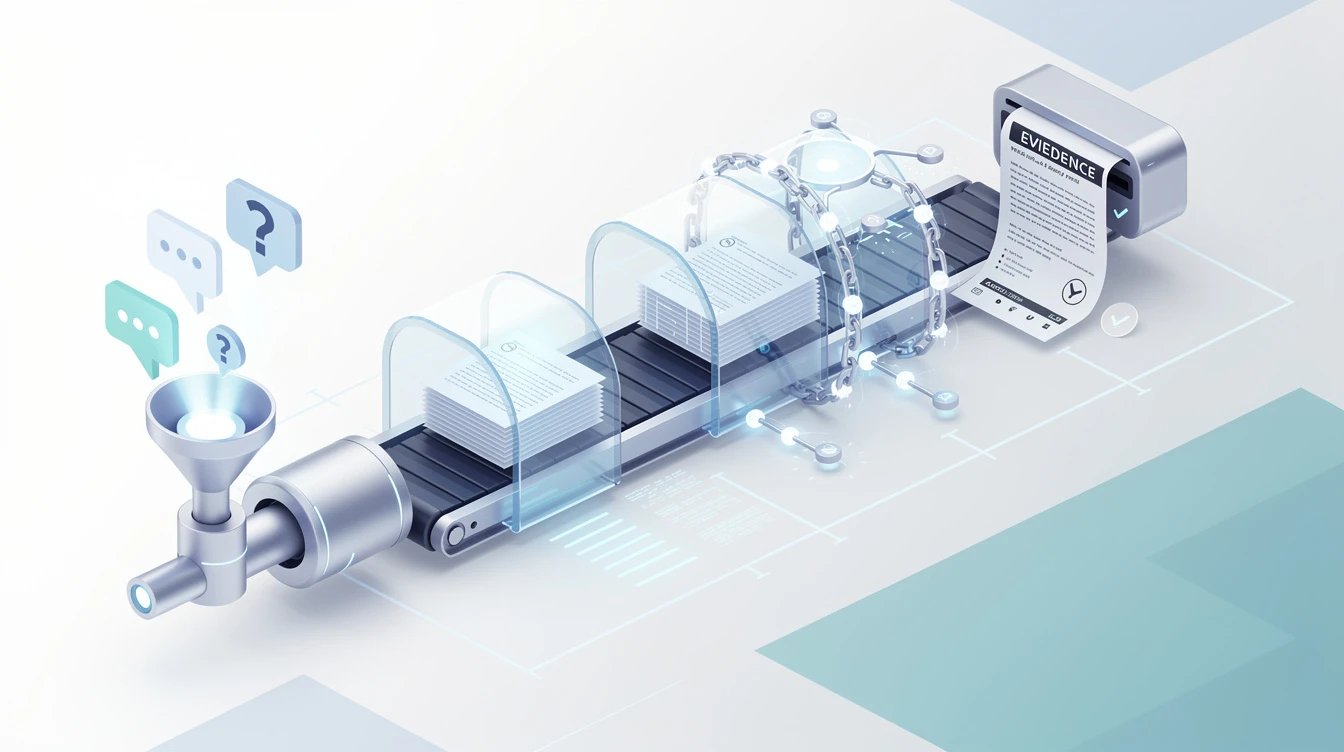
Ask a question, get an answer with a full evidence trail
CueCrux searches curated sources, synthesizes answers, and generates verifiable evidence receipts for every response.
Read the full card →
Light, Verified, and Audit modes for different rigour levels
Three modes let you choose your evidence depth: Light for fast answers, Verified for full receipts, Audit for regulatory-grade proof.
Read the full card →
Quick, verified, and audit: choose your level of rigour
CueCrux offers three search modes with increasing depth and evidence rigour: quick for fast answers, verified for sourced confidence, and audit for exhaustive analysis.
Read the full card →
Multi-signal authority scoring with full transparency
CueCrux ranks sources using signals including publication authority, recency, citation frequency, domain expertise, and consistency with other evidence.
Read the full card →
Explicit disagreement surfacing instead of silent blending
When sources disagree, CueCrux flags the conflict, presents evidence from each side, and lets you decide which interpretation to trust.
Read the full card →Guide
Structural overview, protocol flow, and layered system design for WebCrux.
Read the full card →