
Explainer
How does CueCrux actually work?
Ask a question, get an answer with a full evidence trail
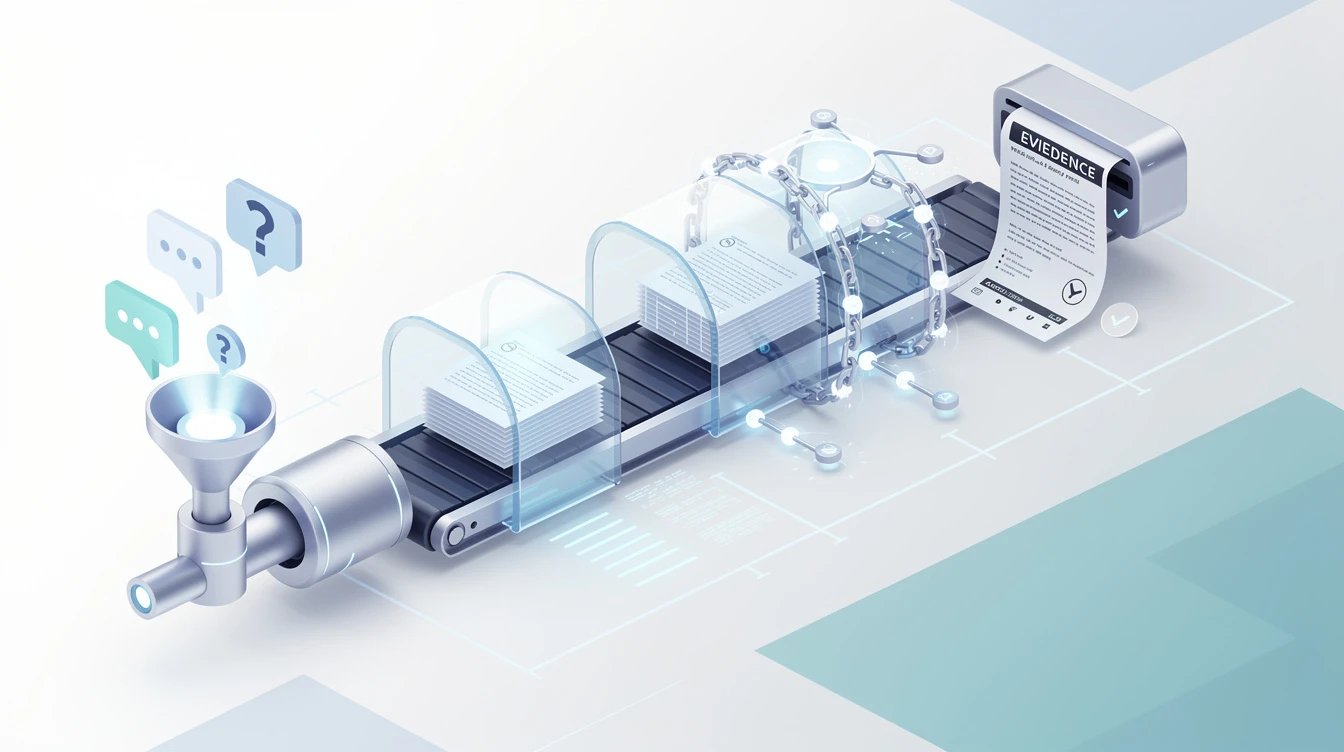
When you use CueCrux, the experience starts simply: you type a question. Behind the scenes, a carefully orchestrated process ensures your answer is both accurate and provable.
First, your question is analyzed to understand what you are really asking. This is not just keyword matching. The system interprets the intent behind your question, identifies the key concepts, and determines what kind of evidence would constitute a good answer. If you ask "What are the GDPR requirements for data retention in healthcare?", the system understands it needs to find regulatory text, sector-specific guidance, and possibly relevant enforcement decisions.
Next, the system searches its knowledge corpus using multiple retrieval strategies running in parallel. One strategy looks for exact keyword matches in source documents. Another uses semantic understanding to find passages that discuss the same concepts even if they use different terminology. A third checks for structured data like tables, timelines, and regulatory citations. By combining these approaches, CueCrux finds relevant information that any single method would miss.
Once the relevant source passages are identified, the system synthesizes them into a coherent answer. This is where CueCrux differs fundamentally from a traditional search engine. Instead of giving you a list of links to read through yourself, it assembles the information into a direct answer to your question. But unlike an AI chatbot, it does not generate this answer from memorized training data. Every claim in the answer is directly tied to a specific source passage that you can inspect.
As the answer is being constructed, the system simultaneously builds a CROWN receipt. This receipt is the evidence backbone of every CueCrux response. It records which sources were consulted, which passages were selected, how relevant each passage was scored, what confidence level applies to each claim, and when each source was last verified. The receipt is cryptographically signed so you can confirm it has not been altered after the fact.
The answer appears on your screen with inline citations. Each citation is clickable and takes you directly to the relevant passage in the original source. If a claim is well-supported by multiple high-quality sources, it gets a high confidence indicator. If a claim relies on a single source or an older document, the confidence indicator reflects that. You always know how much weight to give each part of the answer.
You can interact with the answer in several ways. You can ask follow-up questions that build on the context of your original query. You can expand any citation to see the full source passage in context. You can open the complete receipt to examine the entire evidence chain. You can share the answer with colleagues via a proof link that lets them verify everything independently. And you can save answers to workspaces for ongoing reference.
For ongoing research needs, you can set up watches on topics or sources. When something changes in the underlying evidence, CueCrux notifies you with a structured diff showing exactly what is different. This means your research stays current without manual re-checking.
The entire process is designed to be transparent at every level. There is no hidden logic, no unexplainable rankings, no "trust me" moments. If you want to understand why CueCrux gave a particular answer, the receipt gives you the complete picture. If you disagree with the answer, you can see exactly which sources to challenge. This transparency is what makes CueCrux suitable for professional contexts where accountability matters.