

Core system
OpsCrux
Operations control tower with live supervision and approval gating
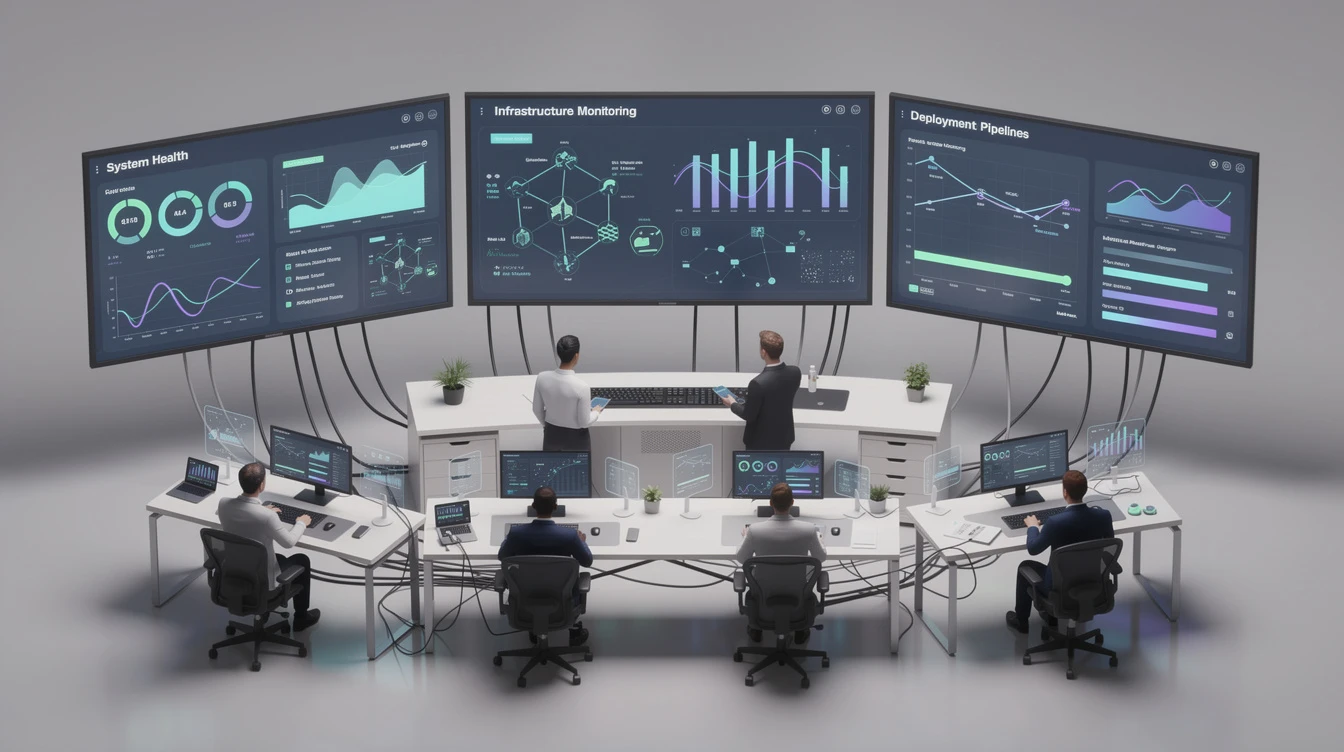
OpsCrux is the operations control tower for the CueCrux platform, providing operators with live supervision, approval gating, and comprehensive dashboards for managing the health and performance of all platform services. It is where the human-in-the-loop principle is operationalised, ensuring that automated systems remain accountable and that state-changing actions receive appropriate oversight.
The centrepiece of OpsCrux is the Agent Theatre, a real-time visualisation of agent runs across the AgentCrux mesh. Operators can watch live execution traces as planner, researcher, implementer, and auditor agents work through their tasks. Each step is displayed with its inputs, outputs, and resource consumption, giving operators complete visibility into what the automated systems are doing and why. When an agent encounters a decision point that exceeds its authority or budget, the Theatre surfaces an approval request that the operator can accept, reject, or modify before execution continues.
Approval gates are a critical safety mechanism. Not all actions are equal in their potential impact, and OpsCrux enforces a graduated approval framework. Low-risk read operations proceed automatically, while state-changing actions like corpus modifications, access policy updates, or budget reallocations require explicit operator approval. The approval framework is configurable per tenant and per action type, allowing organisations to calibrate the level of human oversight to their risk tolerance.
Beyond the Agent Theatre, OpsCrux aggregates operational metrics from across the entire platform into unified dashboards. These dashboards display service health indicators from WatchCrux, retrieval performance statistics from Engine, ingestion pipeline throughput from FactoryCrux, storage utilisation from CoreCrux, and encryption key status from VaultCrux. Operators can drill down from high-level summaries to individual service metrics, identifying bottlenecks and anomalies before they affect end users.
Usage analytics provide a business-level view of platform activity. Operators can see query volumes, answer generation rates, receipt verification counts, and tenant-level resource consumption. These analytics feed into capacity planning, billing calculations, and product development decisions. Budget consumption tracking ensures that tenant spending remains within agreed limits, with automatic alerts when usage approaches thresholds.
OpsCrux also provides incident management capabilities. When WatchCrux detects critical drift or a service health alert fires, OpsCrux coordinates the response by surfacing relevant context, suggesting remediation steps, and tracking resolution progress. Historical incident data is preserved for post-mortem analysis and process improvement.
For the CueCrux platform as a whole, OpsCrux serves as the human interface to operational complexity. It transforms raw telemetry, metrics, and events into actionable intelligence that operators can use to keep the platform running reliably, efficiently, and within its defined safety boundaries. It is the control surface that makes CueCrux not just technically sophisticated but operationally manageable.