

Explainer
Does document quality affect answer accuracy?
Yes, and CueCrux tells you exactly how much
This is an important and often overlooked question. The short answer is yes, the quality of the documents you upload absolutely affects the quality of the answers you get from them. But CueCrux is designed to be transparent about this rather than hiding it, which is a significant difference from most AI tools.
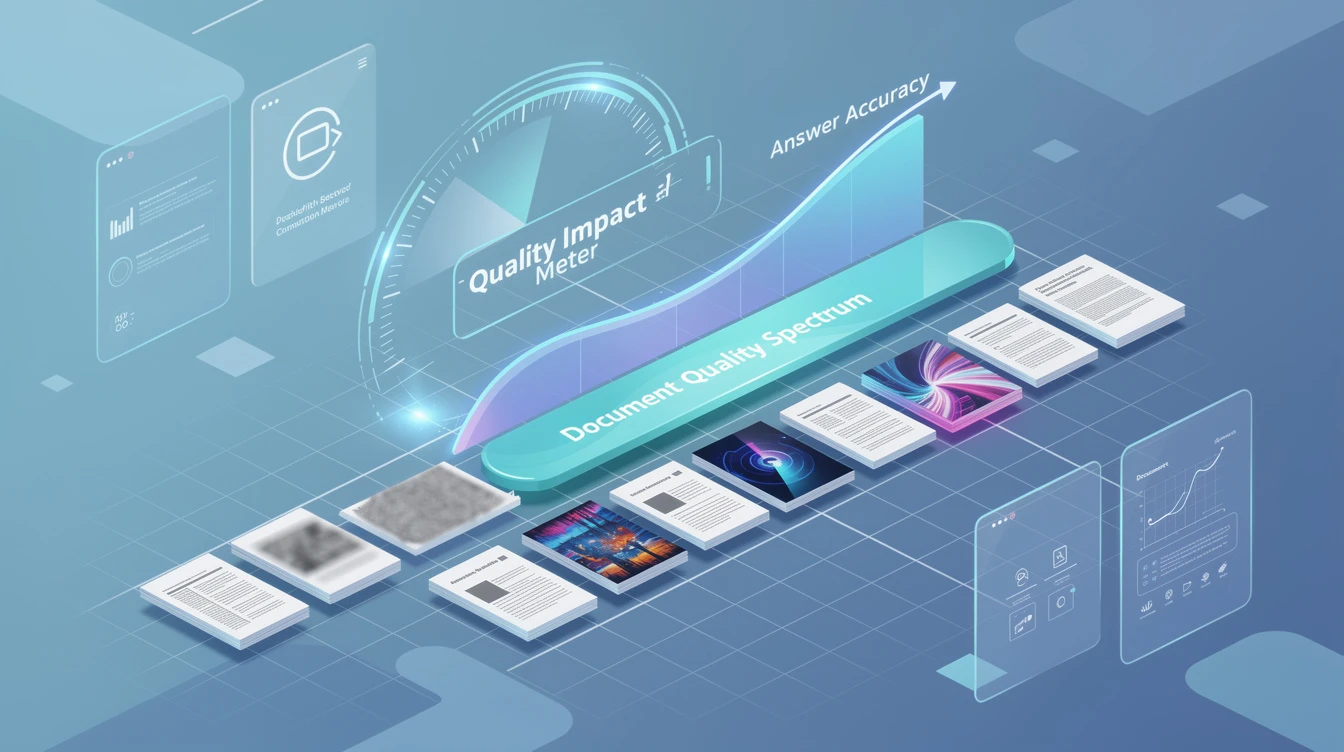
When we talk about document quality in this context, we mean several things. First, there is extraction quality. How well was the text extracted from the original file? For a natively digital Word document, extraction quality is essentially perfect because the text is already in a machine-readable format. For a scanned PDF, extraction quality depends on the scan resolution, the clarity of the original print, and the accuracy of the OCR process. For a photograph of a document, extraction quality depends on lighting, angle, and focus.
Second, there is content quality. Is the document itself well-structured, clearly written, and internally consistent? A well-organised report with clear headings, numbered sections, and a logical flow is easier for CueCrux to understand and chunk effectively than a sprawling, unstructured document with inconsistent formatting.
Third, there is currency. Is the document up to date? A regulatory filing from five years ago might contain information that has since been superseded. CueCrux tracks when documents were uploaded and can flag when the age of a document might affect the reliability of information drawn from it.
CueCrux addresses each of these quality dimensions explicitly. During ingestion, every chunk of text is assigned quality metadata. For OCR-processed content, this includes confidence scores that indicate how certain the system is about the extracted text. For all content, structural quality indicators note whether the chunk has clear context, whether it is part of a well-structured section, and whether there are any formatting anomalies that might indicate extraction problems.
When you ask a question and CueCrux draws on your uploaded documents to construct an answer, the quality metadata travels with the evidence. If a key claim in the answer comes from a high-quality, cleanly extracted chunk of a well-structured document, the receipt will reflect that confidence. If a claim comes from a low-confidence OCR extraction or a poorly structured document, the receipt will flag that too.
In the answer interface, this shows up as quality indicators alongside the source citations. You might see something like a green indicator for a claim sourced from a high-quality digital document, or an amber indicator for a claim sourced from a moderate-quality scan. This does not mean the answer is wrong. It means CueCrux is telling you "this particular piece of evidence has some uncertainty attached to it, and you might want to verify it against the original document."
This transparency is especially valuable in professional settings. If you are assembling a research report or making a compliance determination, knowing which parts of your evidence base are rock-solid and which might need verification is enormously useful. It helps you allocate your review time effectively, focusing your attention on the claims that rest on weaker evidence rather than re-checking everything.
CueCrux also provides document-level quality summaries in your workspace. You can see at a glance which of your uploaded documents have high extraction quality and which have issues. This helps you prioritise document maintenance. If an important contract was scanned at low resolution and the OCR quality is mediocre, you might decide to rescan it at higher quality or obtain a digital copy.
There are some things you can do to maximise document quality. Use natively digital formats whenever possible. If you must upload scans, use the highest resolution available. Keep documents well-structured with clear headings and consistent formatting. And keep your document library current by replacing outdated versions with updated ones.
The key takeaway is that CueCrux does not pretend that all sources are equally reliable. It measures quality, reports it transparently, and lets you make informed decisions about how much weight to give each piece of evidence. This honesty about uncertainty is a core part of what makes receipted search trustworthy.